
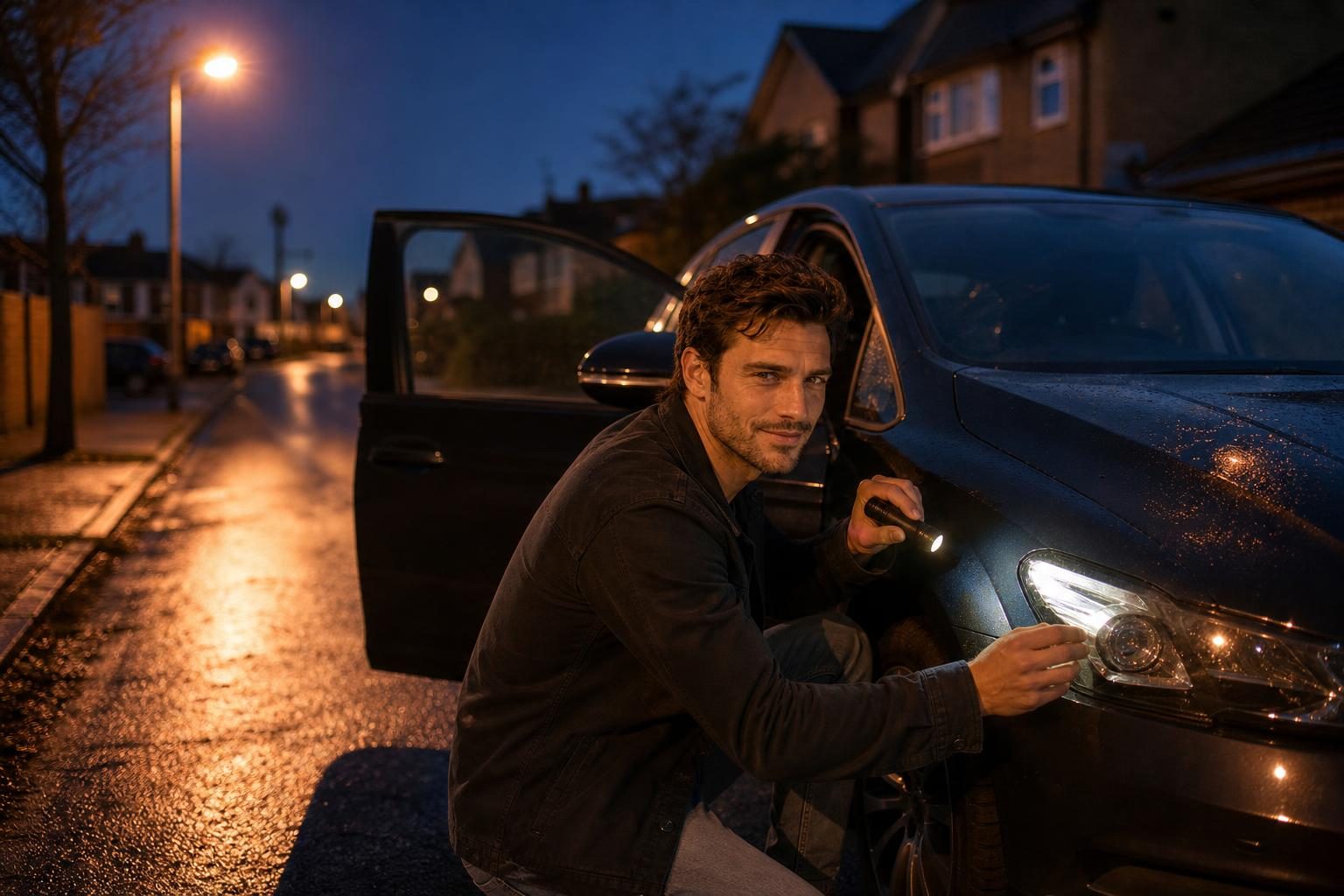
What you will do and how long it will take
The clocks go back at 2am on Sunday 25 October 2026, and from that Monday morning many drivers will face their commute in the dark for the first time since spring. The checks below take around 30 to 45 minutes in total, need no special tools for most cars, and cost nothing beyond any parts you need to replace.
Difficulty: easy for the visual checks and most halogen bulb swaps. Some bulb types need a professional.
Rough cost: nothing if everything is already working. Halogen bulbs from around £5; wiper blades from around £15 for a basic pair.
Safety first
The RAC reports that when the clocks go back there is a spike in vulnerable road users killed or seriously injured. A third of drivers report feeling nervous about judging distances at night. The checks below directly reduce that risk.
Before you start:
- Park on a flat, level surface with the engine off.
- If you need to check the rear of the car while it is on a public road, make sure it is safe to walk around the vehicle.
- Do not touch halogen headlamp bulbs with bare hands. The oil from your skin can cause the bulb to fail early or crack. Use a clean cloth or gloves.
- Never attempt to work on Xenon or HID headlamp systems yourself. They use high voltages and can cause serious injury even with the engine off. Have them fitted by a professional.
- Do not use wipers to clear ice. Scrape or de-ice the screen first. Forcing a wiper blade that is frozen to the glass will damage the rubber.
What you need
For the checks themselves you need nothing but your eyes and a torch. If something needs replacing, here is what to budget (UK indicative prices, October 2026):
Headlight bulbs
- Halogen: roughly £5 to £30 per bulb
- Xenon or HID: roughly £20 to £100 per bulb, plus professional fitting strongly recommended
- LED replacement bulbs: roughly £10 to £150, but see the LED note in the troubleshooting section below
Bumper.co reports that professional bulb replacement fees range from around £15 to £100, and that Halfords typically charges around £8 to £15 to fit a headlight bulb, often fitting free when you buy the bulb in store. Full garage labour for headlamps that require bumper or wheel arch liner removal can exceed £80 at a main dealer. Motorway’s guide gives a useful breakdown by bulb type.
Number plate bulb Usually a small festoon or wedge bulb. Expect to pay £3 to £10.
Wiper blades Basic conventional blades start at around £15 to £30 for a pair. Beam or hybrid blades run from £30 to £60 or more.
Check your car first
Bulb types and wiper blade sizes vary by make, model and year. Before buying anything, check your owner’s manual or use the parts finder on a major motor factor website (Halfords, Euro Car Parts and Autodoc all have them). Enter your registration number and it will list the exact bulb reference and wiper sizes for your car. Getting this wrong wastes money.
Numbered steps
1. Check your headlights, front and rear
Park facing a wall or garage door at about two metres. Turn on dipped headlights and walk around. Both beams should be bright, equal in colour and aimed at roughly the same height. One noticeably lower or dimmer than the other suggests a failing bulb or a misaligned unit. Check sidelights and full beam while you are there.
If you suspect your headlights are misaimed, do not attempt to adjust them yourself. Misaligned headlights dazzle oncoming drivers and are a potential MOT failure point. Have them checked and adjusted by a professional.
2. Check the number plate light
UK law requires a working white light to illuminate the rear number plate from sunset to sunrise, under the Road Vehicles Lighting Regulations 1989. A failed number plate bulb is enough to fail an MOT, and coloured or flashing lights in this position are illegal and can attract a fine of up to £1,000.
To check: turn on your sidelights and walk to the back of the car. The number plate should be clearly lit in white. If it is not, replace the bulb. On most cars this is a straightforward job involving a small screwdriver to release the lens.
3. Check your fog lights
You must use headlights when you cannot see more than 100 metres ahead. Front and rear fog lights may be used in those conditions, but they must be switched off as soon as visibility improves. Leaving them on when it is not foggy is illegal under the Road Vehicles Lighting Regulations. Test that both fog lights illuminate and that you can switch them off independently.
4. Know the legal rules on lighting times
Sidelights and the number plate light must be lit at night, defined as from 30 minutes after sunset until 30 minutes before sunrise under the Road Vehicles Lighting Regulations 1989. Dipped headlights should be used at night in built-up areas and in dull daytime conditions. On roads with working street lights and a speed limit of 30 mph or below, headlights are not a strict legal requirement, but using them is safer and good practice.
5. Check your wiper blades
Lift each blade away from the screen and run a finger along the rubber edge. If it is cracked, split or stiff, replace it. Then run the wipers on a wet screen. If they smear, judder or leave streaks, they need replacing. Autumn brings rain and road spray almost daily, and a smearing wiper is a serious visibility hazard.
Remember: never use wipers to clear ice. Scrape or de-ice the screen fully before switching them on.
6. Sort your demisting
Condensation builds on the inside of the windscreen because warm, moist air hits cold glass. The RAC advises starting the heater on cold air first, then gradually increasing the temperature as the air inside the car dries out, rather than blasting hot air straight away. Use the air conditioning in combination with the heater if your car has it. Air conditioning removes moisture from the air effectively, even in winter.
Keep a clean microfibre cloth in the car for wiping the inside of the screen. A smeared inner surface scatters light from oncoming vehicles and makes dazzle worse.
7. Deal with dazzle
The RAC reports that an estimated 16.1 million UK drivers experience headlight dazzle, and government data shows approximately 300 collisions a year cite dazzling headlights as a factor.
To reduce it:
- Keep the windscreen clean inside and out. Any smearing multiplies glare.
- Keep glasses and contact lenses clean. If you wear prescription lenses, make sure you are wearing them when driving.
- Adjust your interior mirror to the night setting (the small lever on the bottom of most mirrors dips the reflection angle).
- When an oncoming vehicle dazzles you, look toward the left-hand edge of the road and use the white line to hold your position rather than staring at the approaching lights.
- Keep a pair of sunglasses in the car for low autumn sun. The sun sits much lower in the sky after the clocks change, and glare flickering through bare trees can be briefly blinding.
8. Check your eyesight
The legal standard for driving in the UK is the ability to read a number plate at 20 metres in good daylight. Many people only notice their night vision has deteriorated when autumn arrives and the roads are suddenly dark again. If you find yourself struggling to read signs, squinting at oncoming lights or misjudging distances in the dark, book an eye test before you drive further.
Check it worked
After completing the checks, do a final walk-around at dusk or after dark with the sidelights on. Confirm: both headlights are working and level; the number plate is lit in white; the fog lights come on and go off correctly; the wipers clear the screen cleanly without smearing. Drive a short familiar route and make sure you can read road signs at a comfortable distance without squinting.
Troubleshooting
Bulb keeps blowing: A repeatedly failing bulb can point to a wiring or voltage regulator fault. Have it looked at by a garage.
Headlights look yellow or dim despite good bulbs: The plastic headlamp lens may be clouded or oxidised. Restoration kits exist, but results vary. A garage can advise whether polishing or full unit replacement makes more financial sense.
LED retrofit bulbs: LED bulbs are available for many halogen fittings, but retrofitting LEDs into headlamp units that were not designed for them may not be MOT-compliant. Check with your garage or the DVSA before fitting aftermarket LED headlamp bulbs. LED number plate lights are legal provided they show white light and carry an E-mark certifying they meet the relevant ECE regulation.
Wipers still smearing after new blades: The windscreen itself may be contaminated with wax or road film. Clean it with a proper glass cleaner, not the same cloth you use on the bodywork.
Screen keeps misting up: A persistently misting interior screen can mean a small coolant leak from the heater matrix, or simply that damp items (coats, umbrellas) in the car are releasing moisture. If you notice a sweet smell inside the cabin, have the coolant system checked by a professional.
When to call a professional
Stop and get help if:
- Your headlamps use Xenon or HID bulbs. High-voltage systems are not a DIY job.
- Your headlights need realignment after a bulb swap or after any front-end impact.
- Accessing your headlamp unit requires removing the front bumper or wheel arch liners.
- You have any doubt about your eyesight. See an optometrist before driving at night again.
- Your fog lights, indicators or brake lights have failed. These are all legal requirements and MOT items.
Halfords will fit most standard halogen bulbs for around £8 to £15, often free with a bulb purchase. An independent garage typically charges £15 to £50 depending on access difficulty.
Related notes
If you are buying a used car before winter, the lighting checks above form part of a sensible pre-purchase inspection. Our used car test drive checklist covers the full walk-around in detail.
These checks apply to petrol and diesel cars. If you drive an electric vehicle, the lighting rules are identical, but the 12-volt auxiliary battery that powers the lights is separate from the main drive battery. If your EV or hybrid’s lights are dim or flickering, have the auxiliary battery tested by a professional rather than assuming it is just a bulb.
The one thing to do now: set aside 30 minutes this weekend, grab a torch, and work through the eight steps above. If everything is working, you are ready for darker evenings. If a bulb is blown or a wiper blade is shot, replace it before Monday morning.

